I have always had stage fear. Before this, the only times I walked onto a stage were to collect a prize. Never to give a speech.
Over the past few months I had been working on it, building my communication and my confidence. I spoke up in meetings, pitched VIYLSA one-to-one, and even pitched to a panel of judges in a room. That went well. But it was a room, not a stage. My one-to-one communication was good, so I assumed public speaking was the same skill, just louder. It isn't.
The pitch that came back to me
We weren't prepared. We didn't even know we had a competition on a stage this big. All we knew was that we had to pitch VIYLSA somewhere that day. I had other work piling up, so I asked our CMO, Aena, to make the deck this time and to present it too.
When we got there, we found out it was Mera Brand Pakistan at ICCI, the Islamabad Chamber of Commerce and Industry, and it was a very big competition. I started explaining to Aena how to present each slide on the screen. While I was doing that, the team felt I was presenting really well and explaining the points clearly. I had pitched this many more times than anyone else, and it showed. So the team picked me.
Honestly, I felt confident. The team did too. Maybe we were too confident. I had talked to people about VIYLSA so many times and pitched it in so many meetings that I was sure I knew what to do. I didn't practise once.
A long wait, and still no practice
There were around 30 to 35 pitches that day, and we were second last. That is a long time to sit. Some of it I really enjoyed. I was genuinely interested in everyone's ideas. But once I had heard the problem and the solution, I lost interest in the business plan, the time frame and the rest. I started getting bored.
And through all of it, I still didn't prepare. The team believed in me. I believed in myself. I had pitched everywhere, I knew what to do, and somehow I would go up there and make it work.
When it got real
As our turn came closer, everything started to look bigger. The stage was big. The projector screen in front of it was huge. The auditorium was a very big hall, and it was full of people.
We had been sitting in the last rows. Since our turn was near, the organisers moved us to the front. That's when the anxiety started. I was finally taking it seriously. I hadn't even decided the night before that I would be the one pitching. No rehearsal, no preparation. I had explained a few slides to my team, and the team had chosen me.
I kept telling myself: I'm okay, chill, I can do this. But inside, another voice was saying: please delay this event, somehow cancel it, I don't want to go up there. The stage fear I hadn't felt in a long time was back. I had thought it was over. It wasn't.
Praying for a delay
I went up to the stage, and there were technical issues. The presenter just before us had sent a PDF, but they were only playing PowerPoint files, so his slides couldn't be shown. He explained his idea in his own words and went back.
Ours was a PowerPoint, and it played. I was still praying something would waste some time so I wouldn't have to present. Then the mic and the remote acted up. I kept pressing the remote to move to the next slide, and it didn't respond in my hand. The person assisting on stage told me it was working and tried it himself. Every little delay felt like a rescue. None of them lasted. After all that hoping, I had to do it.
Being second last also meant we were running out of time. The event was already running late. Judges weren't allowed to ask questions to the last few groups, so there was no Q&A for us, and the time limit was strict.
Assalamu Alaikum
I stood at the podium and said Assalamu Alaikum into the mic. I could hear my own voice through the speakers, and it sounded so strange. In my head it felt like it rang two, three times. It didn't. That was just my anxiety.
Then I looked up at the people. From the audience, a stage doesn't look like it faces many people. From the stage, you can see each and every person. There were a lot of people. A lot. The ground slipped from under my feet.
I started and kept explaining, but I don't really know what I was saying. Whatever I had in my head got lost. I knew the order of the slides, but I hadn't prepared what was on them: the numbers, the survey results, the definitions, which points to discuss on each one. I hadn't rehearsed even once. So I kept looking back at the screen to read each slide, and every time I asked the assistant to move to the next page. I think I was explaining too much. I'm still not sure, but I think so.
Where the minutes went
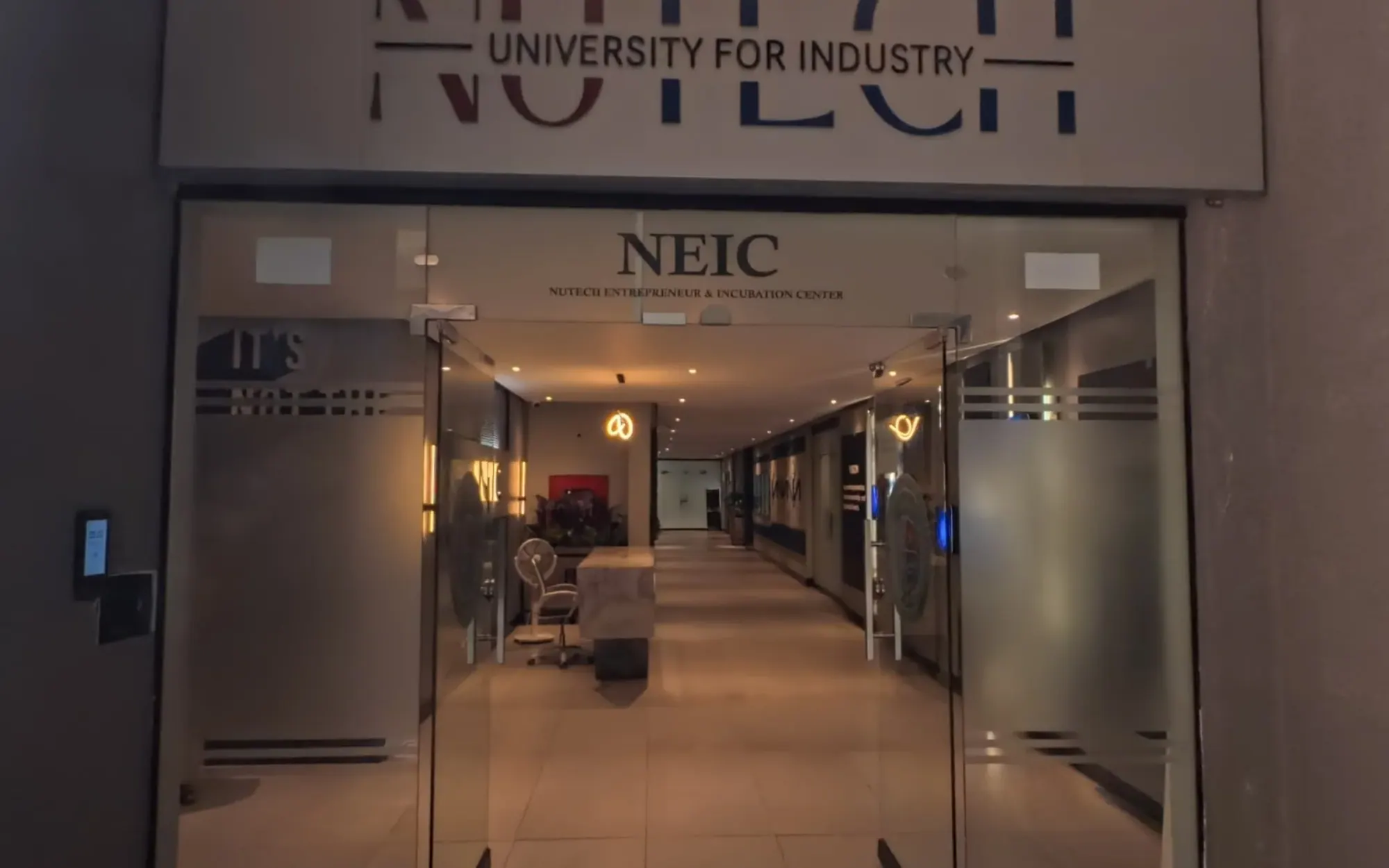
Then we played the demo: the 360° virtual tour of NEIC that we built at VIYLSA to show the public. The team took time opening the link, and I was guiding them to our location inside the tour. All of that took time.
The most important part was still left: our collaborations, our business model, what we had already done. Right after the demo, we were told our time was up. We thought we had more. But the last teams were hardly getting three to four minutes, while the first teams had ten. Some of it was luck, some of it was the technical issues, and maybe some of it was me explaining too much.
If I had known the time was that short, I would have cut everything down. Instead I said thank you and walked off. The pitch didn't close. It just stopped in the middle. We hadn't explained our business model or anything else. We had only demoed a tour. There was no chance for us to win.
The walk back
I came off the stage full of regret. I kept thinking about my team who believed in us, the GM of our incubator, and my seniors who taught me so much about pitching, people I have watched and admired for a long time. I felt like I had broken everyone's expectations. Honestly, I don't think anyone was expecting that much from me. It was all in my mind. But it didn't feel that way.
I kept replaying the possibilities. I could have explained much less. I could have just shown the tour without talking over it, because the tour would have explained every feature by itself. I could have jumped straight to the business model slide and said, "Let me close," before walking off. Anything but saying thank you and leaving, with the judges sitting there thinking we hadn't done anything at all.
Even with all that, I'm thankful for my teammates, who kept telling me I had done my best and that it was just the circumstances. Thank you to Aena, who was so understanding and kept consoling me, and to Saqlain, who supported me and talked through what we could do better next time.
The videos I haven't watched
It was a big event, and friends were recording. They sent me the videos afterwards. I opened one, and before it had played for even a second, I closed it and covered my ears. I couldn't find the courage to hear what I had said up there. I still haven't watched any of them. I decided I wouldn't listen to it, and would just work on improving myself instead.
What I learned
Then it sank in. A first experience is often like this, and you learn a lot from it. I learned a lot from this one.
- Rehearse, every time. Knowing your idea is not the same as knowing your pitch. You can't keep looking back at the slides for every point. It doesn't look good, and it lowers your confidence.
- Don't be overconfident. Pitching in meetings and to a room of judges did not prepare me for a stage.
- Know your details cold. Your numbers, your survey results, your definitions, without looking.
- Don't over-explain. Show. A good demo speaks for itself. Let it.
- Manage your time. If your time gets cut, know what to show and what to skip, and always keep a few seconds to close properly.
- Stage fear is its own skill. Getting better at one-to-one conversations didn't remove it. It needs its own practice.
A founder lesson
Being a founder means pitching. Judges, investors, partners, customers: someone is always asking you to explain why your startup matters, often with less time than you planned for. This pitch didn't win anything for VIYLSA. But it showed me exactly what I need to work on, and I would rather learn it now than at a pitch that decides our future.
Next time, I'm walking on rehearsed.
 Aena Habib
 Saqlain Abbas